
Allocate the winning quantity, to every location.
The right product, at the right store, at the right time. ML forecasts every SKU and store combination daily, with or without sales history, so allocation is optimised for current demand, not 9-month-old plans.
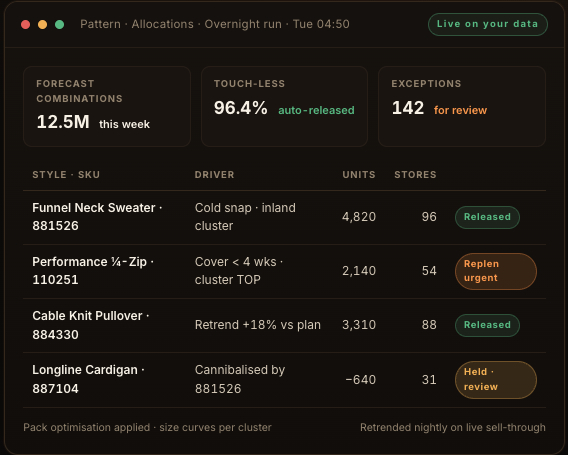
Allocations should be optimised for current demand, not 9-month-old plans.
For planning and trading leadership
5,000 products × 5 sizes × 500 stores is 12,500,000 unique forecasting requirements a week. Impossible in spreadsheets, automated with Pattern, and retrended nightly on live demand.
For allocators and planners
The system handles the volume; your team handles the judgment. Near touch-less allocation releases the routine automatically and queues only true exceptions for review.
For stores and e-commerce
Stores receive what their local demand supports, sized by their own curves. Fewer size breaks on the wall, fewer transfers, fewer markdowns from misallocated depth.
Demand-led execution, at machine scale.
Allocation and replenishment driven by SKU/store-level forecasts, governed by your rules, refreshed every night.
SKU/store demand-led allocation
Allocations driven by in-season demand per SKU per store, not push logic from a static plan. With or without sales history.
In-season retrending
Forecasts retrend nightly on live demand signals, so this week's allocation reflects this week's trading, not the pre-season view.
Weather & cannibalisation aware
Local weather patterns and in-range cannibalisation factored into every store-level forecast, automatically.
Near touch-less operation
Routine allocations release automatically. Exception management queues only the decisions that genuinely need a human.
Pack optimisation engine
Size configurations and pack builds optimised against cluster-level size curves, cutting DC handling without breaking size integrity.
Governed by your rules
Allocation parameters, thresholds and strategies set up. Best practice is centralised, not dependent on individual allocator skill.
Availability up, markdowns down, capacity back.
Allocation is where planning value is finally won or lost. Pattern is tuned to the outcomes that show up in the trading account.
The right product, in the right store, at the right time, in the right size. Demand is met where it lands, and stock-outs and size breaks are designed out rather than fire-fought.
- Dynamic, granular store and size-curve accuracy, tuned to real-time demand
- Store-level allocation and replenishment tuned to local weather and demand drivers
- Pack optimisation that lands size integrity on the wall
- Fewer stock-outs and size breaks
- Higher full-price sell-through and availability
Most markdown is created months earlier by depth landing in the wrong stores. Demand-led placement keeps stock where it sells, so less of it needs rescuing later.
- Initial allocation shaped by store ranges and store-level forecasts
- Replenishment retrended nightly, with cannibalisation factored in
- Lower markdown spend from misallocation
- Cleaner sell-through across the store estate
When 96% of allocation runs touch-less, the team's week moves from processing lines to working exceptions and trading decisions. The skill stays; the drudgery goes.
- Automated overnight runs with exception-only review queues
- Exceptions ranked by value at stake, with full demand context attached
- No over-reliance on individual allocator knowledge or heroics
- Hours per week returned to every allocator
- Consistent allocation quality across the team
Built on the Pattern Engine.
This module consumes the ML Forecaster, the science engines and your governed rules every single night, at full scale.
The Pattern ML Forecaster supplies SKU/store demand forecasts nightly, mapping weather, events and product and store features.
Size curves, optimums and cluster definitions come from Retail Science Engines, the same assets Assortment Studio planned the range with.
Live sales and stock from the data foundation drive retrending, cover calculations and exception detection.
Configured Workflows
Tailored to how you trade
AI Intelligence
Forecasting & reasoning
Retail Science Engines
Optimisation engines & methodologies
Data Foundation
Single extendable model, built for high-volume SKU retail
Data Ingestion
Any source system
Where the plan becomes stock in stores.
Each module maps to a stage in the merchandise planning lifecycle. All draw from the same single source of truth, so what is decided here is already understood everywhere else.
MFP
Budgets & targets
Item Planning
Style & store line plans
Assortment Studio
Cluster-level ranges
Critical Path & PO
Commitment to delivery
Allocations & Replen
Right product, right store
Analytics
In-season intelligence & stock health
Cluster ranges and depth intent that frame initial allocation.
Confirmed receipts and timing that the allocation run executes against.
Nightly SKU/store demand forecasts, with weather, events and feature drivers.
Let the machine do the 12.5 million forecasts.
See Pattern configured on your own data in weeks, not months.