
Set the plan the whole business trades on.
Merchandise Financial Planning is where every season begins, and where every downstream decision connects back to. Budgets and targets flow from the board to the store in one connected thread from budget to buy.
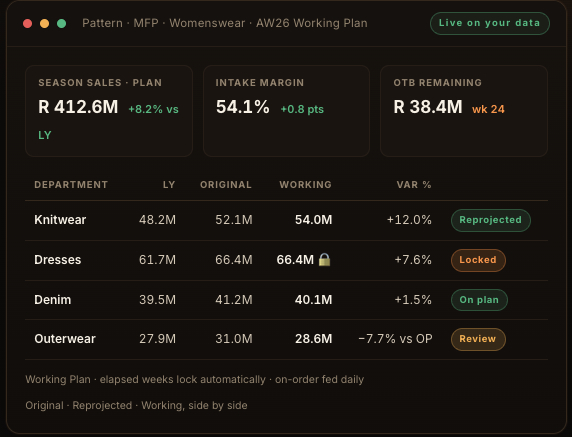
MFP shouldn't be an island. It should be the headwater that feeds every downstream buying, assortment and allocation decision.
For planning leadership
A planning rhythm, not a planning event: an annual budget that locks, a monthly reforecast that copies up, and a weekly trading cycle on live actuals. The plan moves at the speed you trade.
For the exec and the board
Every version visible, every number accountable. Management views read the same live numbers as the merch team, with each plan version owned by a named role, export-ready for board packs.
For procurement and IT
One governed planning layer replaces an estate of uncontrolled spreadsheets. Pattern ingests daily from any ERP, is permissioned and auditable, and is deployed in weeks on your own data.
Planning discipline, without the spreadsheet risk.
Everything a merchandise planning team needs to set, control and reforecast the season, in one governed surface.
Connected planning
Targets flow from MFP through Assortment Studio to Allocations. One connected thread from budget to buy, never re-keyed.
Plan versions & scenarios
Original, Reprojected and Working plans side by side, plus personal scenario workspaces and last-year actuals. Test a strategy before committing it to the plan.
Planning structure, your way
Top-down or bottom-up entry on your real hierarchies, in values or growth vs last year. Supplier or location can sit alongside product and time as a full planning dimension.
Actuals by 8AM Monday
Source feeds run overnight Sunday; elapsed weeks lock automatically; on-order feeds daily, 52 weeks forward. Planners open to a tradeable position, not a data chore.
Plan integrity built in
Cell locking with automatic rebalance, role-based access per version, confirmed version copies, concurrent planning and monthly snapshot retention for audit.
Management views & board packs
The C-suite sees the same live data as the merch team, shaped for review. Export across any measures, products and periods in one click.
What a connected plan is worth.
MFP is configured to your hierarchy and your planning rhythm, then measured on the outcomes that move margin and sales.
Sign-off accelerates when planning, finance and trading all read the same live numbers, and every plan version is owned by a named role. The reconciliation meetings, version-chasing and spreadsheet audits simply fall away.
- Original, Reprojected and Working plans held in one governed model
- Role-based version control: the budget, the reforecast and the working plan each have a clear owner
- Cell locking protects signed-off values while totals rebalance automatically
- Faster plan sign-off
- Every number accountable, no reconciliation overhead
Actuals are loaded, locked and tradeable by 8AM Monday. Weekly near-term adjustments and a monthly official reforecast keep the plan honest while there is still a lever to pull.
- Overnight feeds land actuals by 8AM Monday; elapsed weeks lock automatically
- Weekly cycle for intakes, markdowns and sales; monthly reforecast copies up to the Reprojected Plan
- Forward cover and over/understock health visible against target benchmarks, network-wide
- In-season corrections made weeks earlier
- Stock health managed in-system, not in emailed spreadsheets
A plan only creates value if the buy, the range and the allocation obey it. MFP targets flow into assortment and allocation, and MFP-derived open-to-buy can gate the PO process itself, so no one orders against a category with no OTB.
- MFP targets flow natively into cluster-level assortment plans
- OTB position visible against commitments in Critical Path & PO
- Open-to-buy control at the point of ordering, ending open-chequebook buying
- Plan-to-buy discipline across teams
- Stranded OTB surfaced and redeployed early
Built on the Pattern Engine.
MFP is not a standalone planning tool with an import routine. It is assembled on the Pattern Engine, which is why the plan is live, connected and never re-keyed.
Daily ingestion from any ERP: sales, stock including in-transit, receipts and on-order commitments, 52 weeks forward, locked into the plan with no manual entry.
Your real hierarchies and trading calendar are modelled natively, including supplier or location as planning dimensions where your business needs them.
Retail science reprojection applies your sales curves and seasonality when reforecasting, not naive run-rates.
One source of truth means the targets you set here are the same numbers Assortment, Allocations and Analytics work against.
Configured Workflows
Tailored to how you trade
AI Intelligence
Forecasting & reasoning
Retail Science Engines
Optimisation engines & methodologies
Data Foundation
Single extendable model, built for high-volume SKU retail
Data Ingestion
Any source system
Where every season begins.
Each module maps to a stage in the merchandise planning lifecycle. All draw from the same single source of truth, so what is decided here is already understood everywhere else.
MFP
Budgets & targets
Item Planning
Style & store line plans
Assortment Studio
Cluster-level ranges
Critical Path & PO
Commitment to delivery
Allocations & Replen
Right product, right store
Analytics
In-season intelligence & stock health
In-season performance signals and post-season learnings that shape next season's targets.
Daily sales, stock including in-transit, receipts and on-order from any ERP.
Live commitment and on-order values feeding the OTB position.
Budget and inflow targets that frame cluster-level range plans.
Season targets that allocation performance is measured against.
Management views and board-pack exports, straight from the live plan.
Start the season from one connected plan.
See Pattern configured on your own data in weeks, not months.