
From budget to buy, guided by your customers.
Assortment Studio turns MFP targets into cluster-level range plans built around how your customers actually shop, not just how much each store turns over.
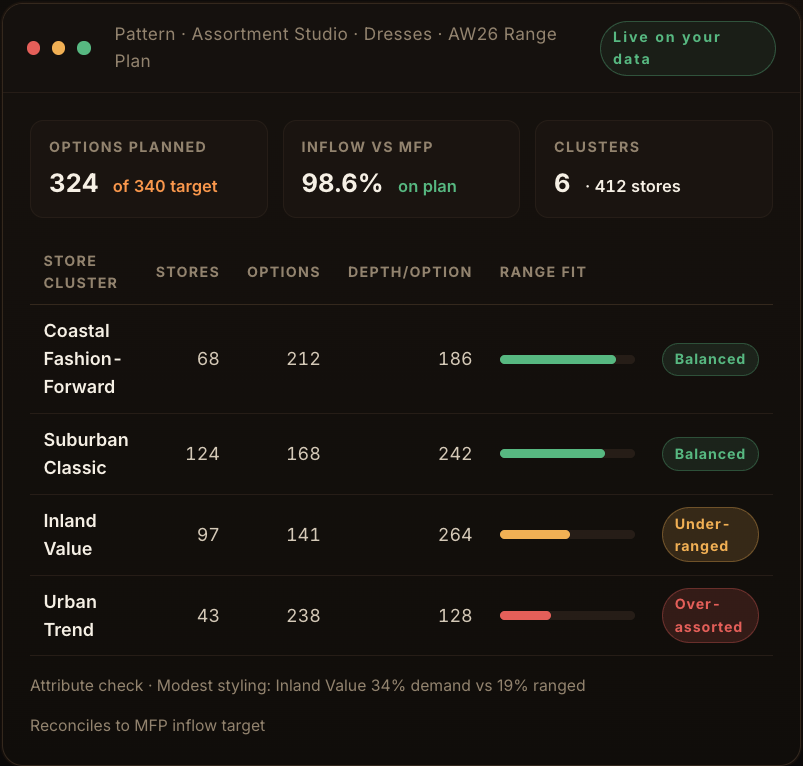
Store grades based on turnover alone are a blunt instrument. Assortments should be built around how your customers actually shop.
For heads of buying and planning
Answer the questions that matter at any point in the cycle: Am I on plan? Over-assorted? Underbought? The range is reconciled to MFP targets continuously, not at the end.
For the buying team
Attribute analysis by cluster before the buy is committed. See whether your coastal stores have enough dresses before sign-off, not in the markdown report afterwards.
For procurement and IT
Clusters, attributes and hierarchies are configured to your data and your structure during the Ignition Cycle. No generic template your teams have to bend to fit.
Range building that reflects how customers shop.
From MFP target to signed-off, cluster-level buy plan, with the evidence to back every call.
MFP to cluster-level plans
Budget targets flow straight into cluster-level buying plans. The financial plan and the range plan are never two documents.
Meaningful store clusters
Clusters reflect how customers shop, not just turnover bands. "Coastal Fashion-Forward" vs "Suburban Classic", built from your data.
Attribute analysis by cluster
Balance the range on the attributes your customers buy: styling, fit, fabric, price architecture. Evidence before commitment.
Hyper-localised range balancing
Track actuals vs targets at cluster level, with assortment factor analysis before final sign-off. Matrix buying, not wedge.
Continuous reconciliation
Options, depth and inflow continuously reconciled to MFP targets, so over-assortment and underbuying surface while they can still be fixed.
Feeds execution directly
Cluster definitions and range plans flow into Allocations and Critical Path, so what was planned is what gets bought, tracked and allocated.
Buy the range your stores can sell.
Assortment Studio is measured on the quality of the buy: trend capture, depth discipline and ranges that fit local demand.
When clusters are built on customer behaviour, the range lands where the demand is. The Inland stores get the modest styling their customers actually buy, and the coastal stores get the fashion depth they can sell.
- Customer-behaviour clusters instead of turnover grades
- Attribute demand vs ranged share, checked per cluster before sign-off
- Hyper-localised balancing across options, depth and price points
- Higher full-price sell-through per cluster
- Fewer ranging misses that end in markdown
Over-assortment quietly strands money in options that never get depth; underbuying strands sales. Continuous reconciliation against MFP keeps the buy honest in both directions.
- Options vs depth visibility per cluster against target
- Over-assorted and under-ranged flags raised during planning
- Inflow reconciled to MFP targets at every stage of the cycle
- Less residual stock in fading categories
- OTB weighted to growth, not last year's shape
Sign-off stops being a debate of opinions when every line of the range carries its evidence: cluster fit, attribute balance and reconciliation to plan, all in the room.
- Assortment factor analysis presented at sign-off
- One working surface shared by buying, planning and locations teams
- Variance to MFP visible live, not discovered in the post-mortem
- Shorter range sign-off cycles
- Buying decisions the whole business can stand behind
Built on the Pattern Engine.
Assortment Studio works because the platform already knows your stores, your customers and your plan. The clusters, curves and targets it builds on are shared assets, not module settings.
Cluster definitions from the retail science engines, built from simple turnover bands to customer-profile-driven groupings, shared with Allocations.
MFP targets flow in natively, so the range plan reconciles to the financial plan without an export in sight.
Attribute and sales history from the data foundation powers cluster demand analysis at any level of your hierarchy.
Retail science engines supply size curves and optimums, so range depth decisions reflect real selling patterns.
Configured Workflows
Tailored to how you trade
AI Intelligence
Forecasting & reasoning
Retail Science Engines
Optimisation engines & methodologies
Data Foundation
Single extendable model, built for high-volume SKU retail
Data Ingestion
Any source system
The bridge from plan to buy.
Each module maps to a stage in the merchandise planning lifecycle. All draw from the same single source of truth, so what is decided here is already understood everywhere else.
MFP
Budgets & targets
Item Planning
Style & store line plans
Assortment Studio
Cluster-level ranges
Critical Path & PO
Commitment to delivery
Allocations & Replen
Right product, right store
Analytics
In-season intelligence & stock health
Budget and inflow targets that frame the range plan per cluster.
Cluster definitions, size curves and optimums, owned and tuned by your team.
Attribute and trend performance that informs next season's range architecture.
The committed buy plan that POs are raised and tracked against.
Cluster ranges and depth intent that shape initial allocation.
Planned inflow, reconciled back so the financial plan stays true.
Build the next range around your customers.
See Pattern configured on your own data in weeks, not months.